The town of Køge was once the backdrop for one of history’s most violent poltergeist outbreaks—a series of events that sparked Denmark’s largest witch hunt
Køge is a modest-sized town south of Copenhagen that no longer plays a central role in national affairs. In the early 17th century, however, a merchant’s house in the town centre became the epicenter of a protracted series of terrifying disturbances running from 1608 to 1615, culminating in a series of witch trials and executions. Today, a commemorative plaque marks the site of the long-since demolished property, remembering the phenomenon known in Danish history as Køge Huskors.
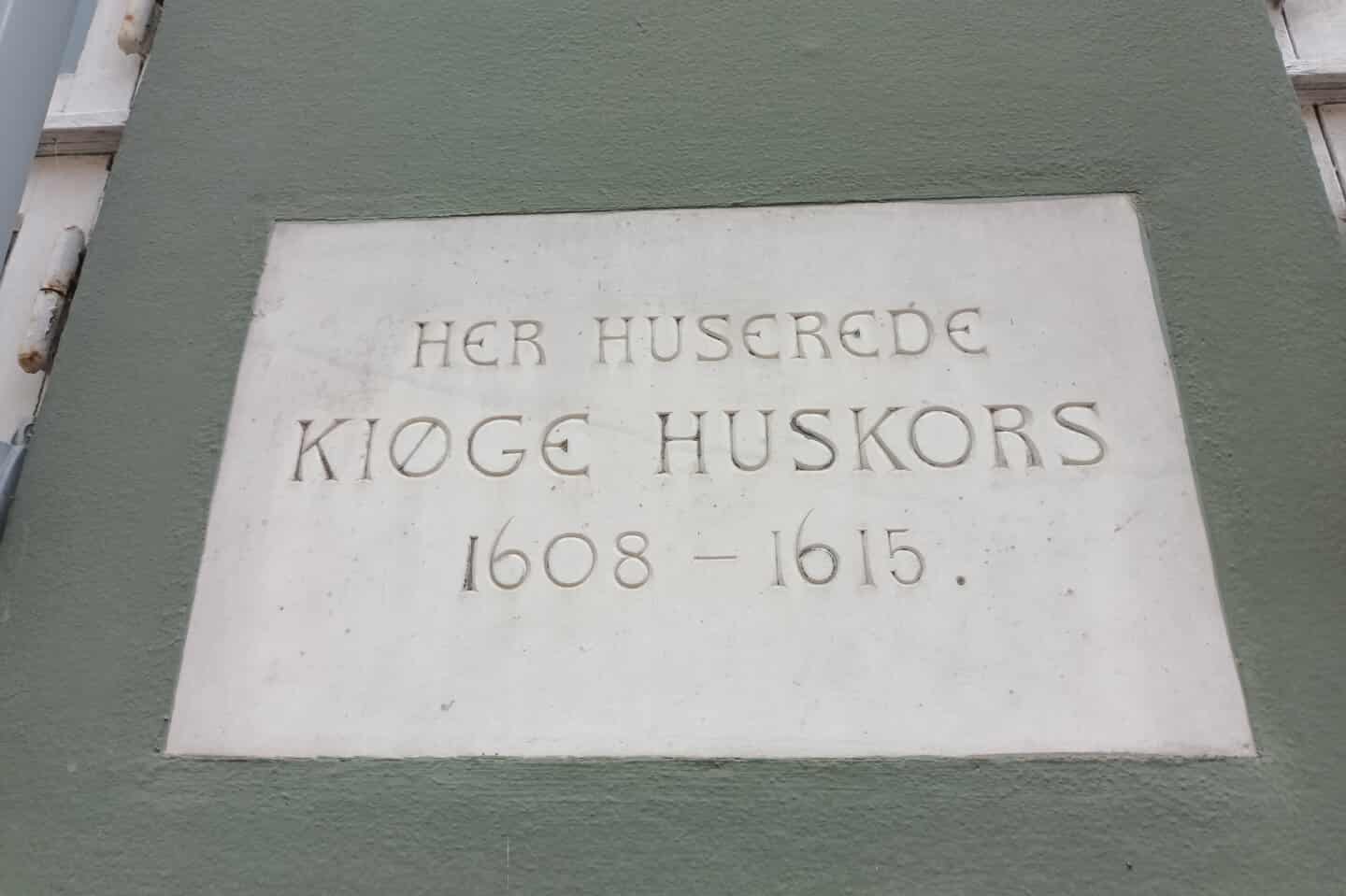
Plaque at Køge town square, where the notorious house once stood, commemorating the events. It reads: “Here once roamed the Huskors of Køge 1608–1615”
The term huskors, which translates directly to “house cross”, is a now archaic phrase signifying a heavy domestic affliction, trial, or spiritual burden. ‘Køge Huskors’ is typically used to refer to two distinct things: the collective events that centered around the household during those years, or more specifically the “force” believed to be behind the mischief. In this article, I will use the term Huskors in a more abstract way, to refer to the collective, supernatural happenings that took place.
The primary targets of the Køge Huskors were a merchant named Hans Bartskjær, his wife Anna, and their children. But also servants, live-in relatives, visitors, and even domestic animals were swept into the turmoil. At its peak, the events spilled beyond the merchant house’s walls and engulfed the entire town.
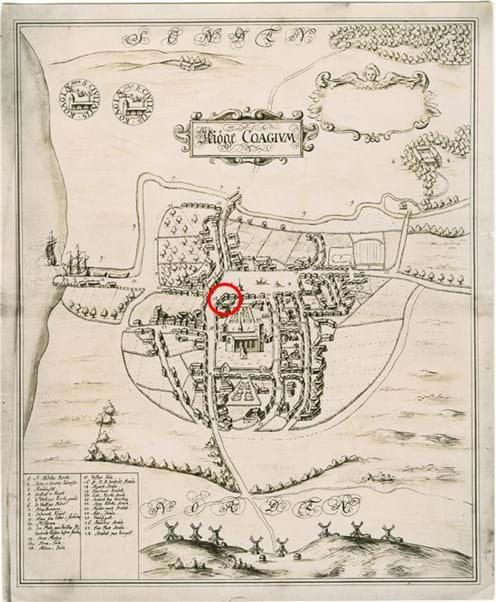
17th century map of Køge, with the location of the Bartskjær house encircled.
Polter (or poultry?) geist activity
It all appears to have started with one particular incident: Anna and Hans Bartskjær were lying in bed one night, when all of a sudden they heard from underneath their pillow, a sound like the clucking of a hen calling on its chicks. A frantic search through the bedding sheets, and eventually the bed itself, produced no such animal — or indeed anything else they could attribute the sound to. After this very modest introduction, however, the huskors quickly stepped up its activities.
Operating with classic trickster-like volatility, the huskors fluctuated between invisibility and tangible forms. When unseen, it hurled furniture, displaced personal items that later reappeared elsewhere, and physically assaulted the household. On one occasion, the family’s small dog was seized by an invisible force, slammed against the ceiling, and violently thrown to the floor. When the terrified animal tried to hide, it was dragged out by the scruff of its neck and abused once more. The next day, aggressive and erratic, the dog had to be put down.
Sometimes people would get the same treatment as the animals. The youngest Bartskjær son, only 2 years old at the time, fell into a fit where he pulled tufts of hair out of his head and tore his clothes off. Once when the eldest son was lying ill, his bed was lifted 1 meter into the air, dropped again and bounced up and down. Anna went to get her husband, but when they came back to their son’s room they discovered that he had been taken out of bed and was standing on his head with his arms stretched out. Only after an intense struggle did they manage to get him back into bed.
A young nephew or cousin to Hans Bartskjær, Jacob, who was living with the family at the time, experienced something similar one day at the dinner table. Suddenly he was pulled away from the table and out into the courtyard, quickly followed (on foot) by the rest of the family. Here he was found dangling high above the ground, feet down and arms stretched upwards and his chin moving up and down, as if it was about to come off. Everybody tried their hardest to get him down, but nothing worked. Finally the family resorted to prayer, which seems to have had an effect, as the boy eventually fell to the ground again. Following this was a loud rumble which sounded like a deep voice, although no one could make sense of what was said. At the same time came a glowing fireball that shot from one end of the courtyard to the other.
A menagerie of bizarre entities
The huskors frequently manifested as strange, polymorphic apparitions too—displaying a distinct preference for animal forms. Shortly after the initial clucking incident, Anna Bartskjær encountered a hideous toad with elongated, hen-like legs strutting toward her through the courtyard gates. Frightenedly, she called out to the other members of the household, but when they arrived outside the creature had faded away. On later occasions the huskors appeared as a goose, a raven, a dog, a rat, a pig and even a monkey.
The huskors also adopted grotesque humanoid shapes. One night there was a loud scream from the attic. Anne and Hans’ youngest daughter Lisbeth came crying down the stairs, relaying that a terrible creature had grabbed her shirt and told her it was going to take her. She described it as a man-like being with eyes like dishes and feet and claws like those of a hen.
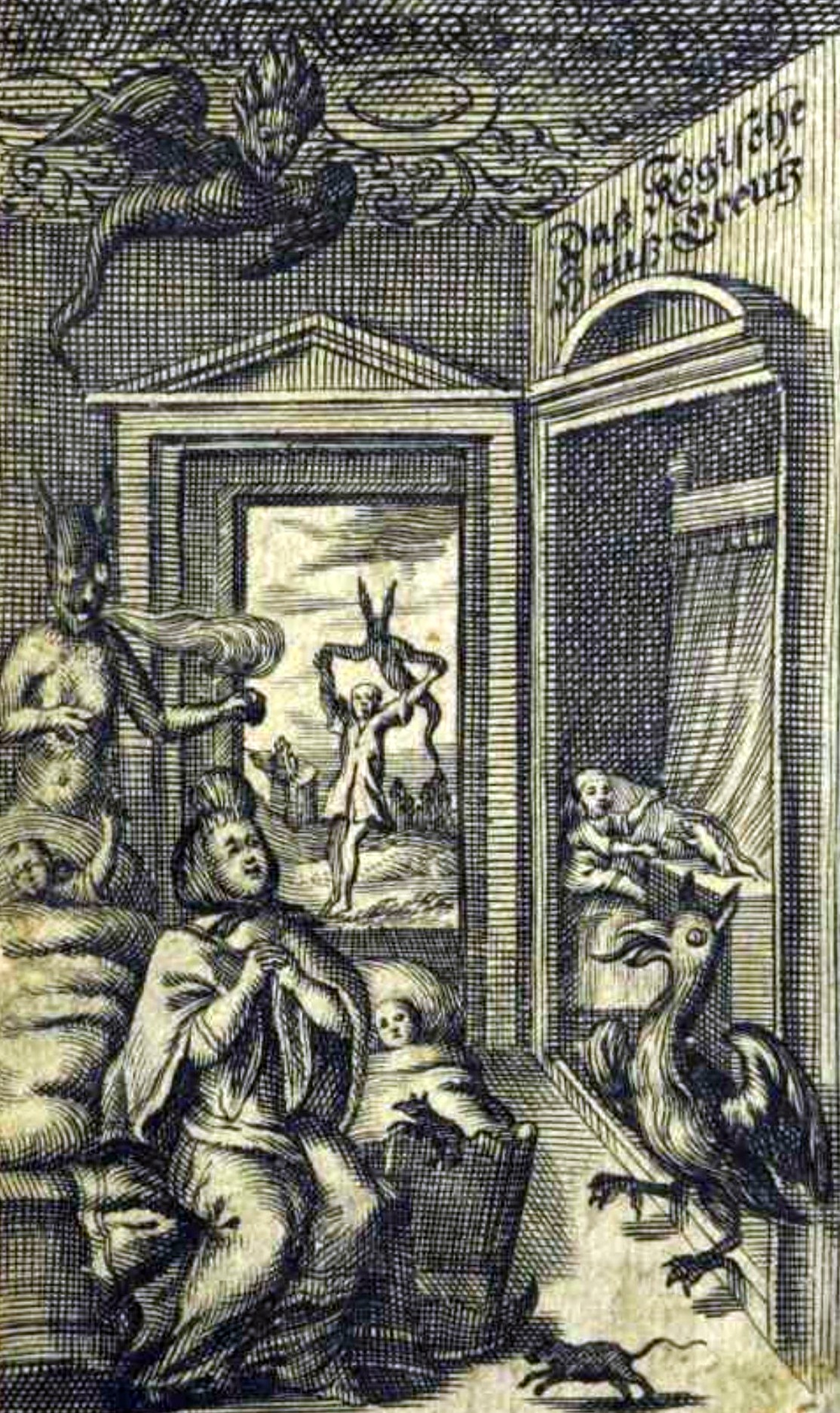
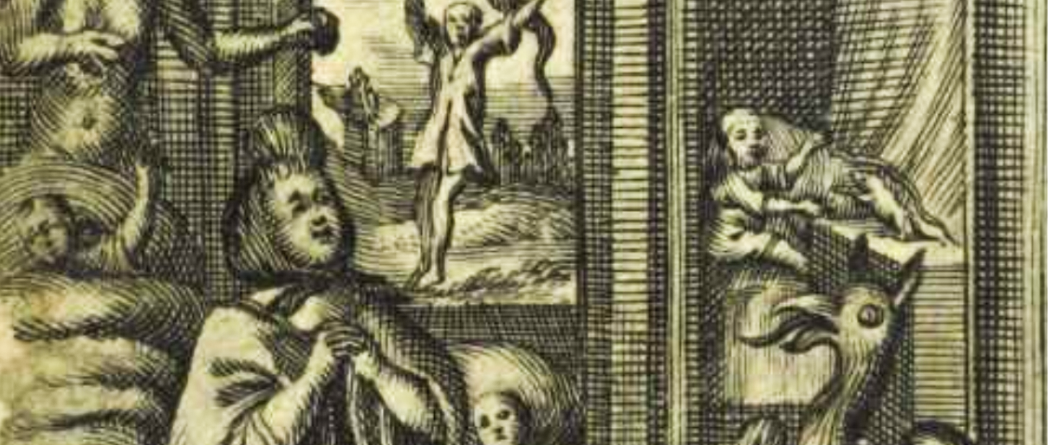
The various guises of the Køge Huskors. Taken from the title leaf of the German edition (1696) of the book “Et forfærdeligt huskors” by Johan Brunsmand.
At its most insidious, the huskors engaged in outright mimicry. Returning home from choir practice one night, Anna found the household in an uproar around her mother, whose face was frozen in a grotesque facial distortion with her legs thrashing violently. The mother accused Anna of physically assaulting her earlier that afternoon. It turns out that the huskors had assumed Anna’s likeness in her absence, to torment the elderly woman.
Nor were the manifestations confined to the Bartskjær property. One time, Anna had to leave town to pursue an errand. On the way back the horsecarriage became so heavy, for no apparent reason, that she was delayed until long after midnight — unreasonably late for what was normally a routine trip. The moment she finally arrived at the house, the clock struck 1 and the trees in the garden started to creak, while some huge object, like a tower, rose into the air. From it came a terrible voice, but its words were undecipherable. Terrified and exhausted, Anna Bartskjær managed to finally get inside and climb into bed.
Various strange ailments
Hans, Anna, and many others, experienced various physical afflictions during their time with the huskors – often strange, unknown diseases and symptoms. One of the servants was bedridden for half a year, and the oldest daughter had one experience which left her so sick that she couldn’t hold any food down for three days. The huskors seemed to have it in particularly bad for the nephew Jacob. Sometimes he was found lying as if crucified, with his eyes rolled back. At one time he didn’t sleep for a whole month because he was so relentlessly haunted and attacked. This, of course, took a heavy toll on him and drained him of all his energy. Then one day he stood up and everything was fine. He was never personally troubled by the huskors again.
The same could not be said for Hans Bartskjær. Shortly after Jacob had become well again, Hans started to act strangely around the rest of the family. After it had gone on for some weeks, he finally told them that every day for several hours during that period, something invisible had hung onto him heavily, like a sack of corn. Sometimes it felt like a hard egg jabbing into one side of his body, and often he fainted due to the pain.
Next, the oldest son started to complain about severe abdominal pains. Sometimes a bump would appear on his stomach and move around, making noises like a pig chewing. He let out animalistic groans, spat blood, and suffered catatonic episodes where his limbs locked so rigidly that he could be propped against a wall like a plank of wood. After a while, he also became well, and it seemed as if the tests of the Køge Huskors were now over. In the meantime, however, Hans Bartskær had died. But the spectacle was not to end for a couple more years.
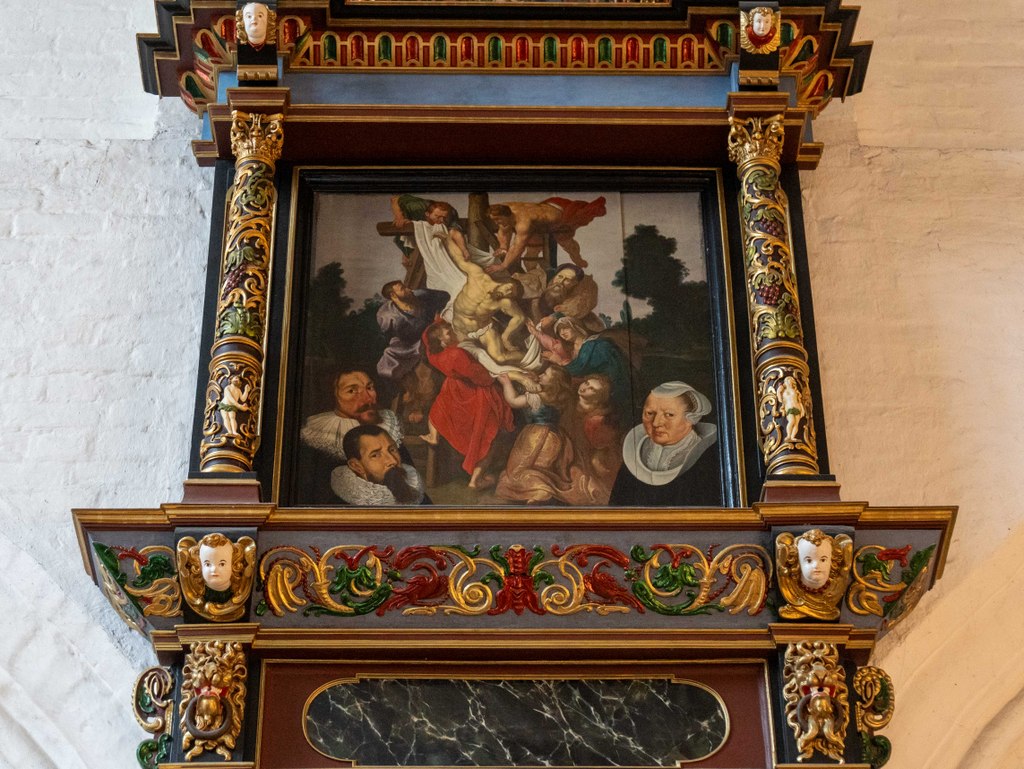
According to some sources, this epitaph from Køge St. Nicolai Church depicts Hans and Anna Bartskjær, with the third figure in the lower left corner believed to be Anna’s subsequent husband Kort Richters.
Placing the blame
Although we would view things a lot differently today, back then there were not many options as to who or what could be the source of such disturbances. In fact, could be only one: The Devil.
How the evil one had gotten into the Bartskjær house to begin with was discussed continually among the affected. For a while the foster son Jacob was accused, but this line of thought was soon dropped. The speculation instead went back to one time, when the huskors had indicated to Hans Bartskjær that a woman in town had sent the devil after them on purpose, and that only when the culprit was found and brought to justice would things go back to normal again. It so happened that one local woman, Johanne Thomeses, some time prior to the affair had been in a dispute with Hans Bartskjær over a property deal that had ended in a harsh exchange of words. It was therefore not too hard to place the blame on her, especially since there was already a widespread belief in witches around Køge, and Johanne Thomeses was a much maligned person locally.
An all too familiar tale then ensued, where a whole network of fellow conspirators, most of them women, was slowly unraveled – one implicating another and so on, all under questionable methods of “persuasion”.
An associate of Johanne Thomeses testified that they together had conjured up the evil one from Thomeses backyard well, in the guise of a rat. There was also a similar ritual a while later at a creek outside the town limits. Both supposedly initiated with the purpose of targeting the Bartskjær household. One of the episodes that gained the most attention and outcry during this time, was the defilement of Saint Nicolai Church baptismal fount by one of the accused women.
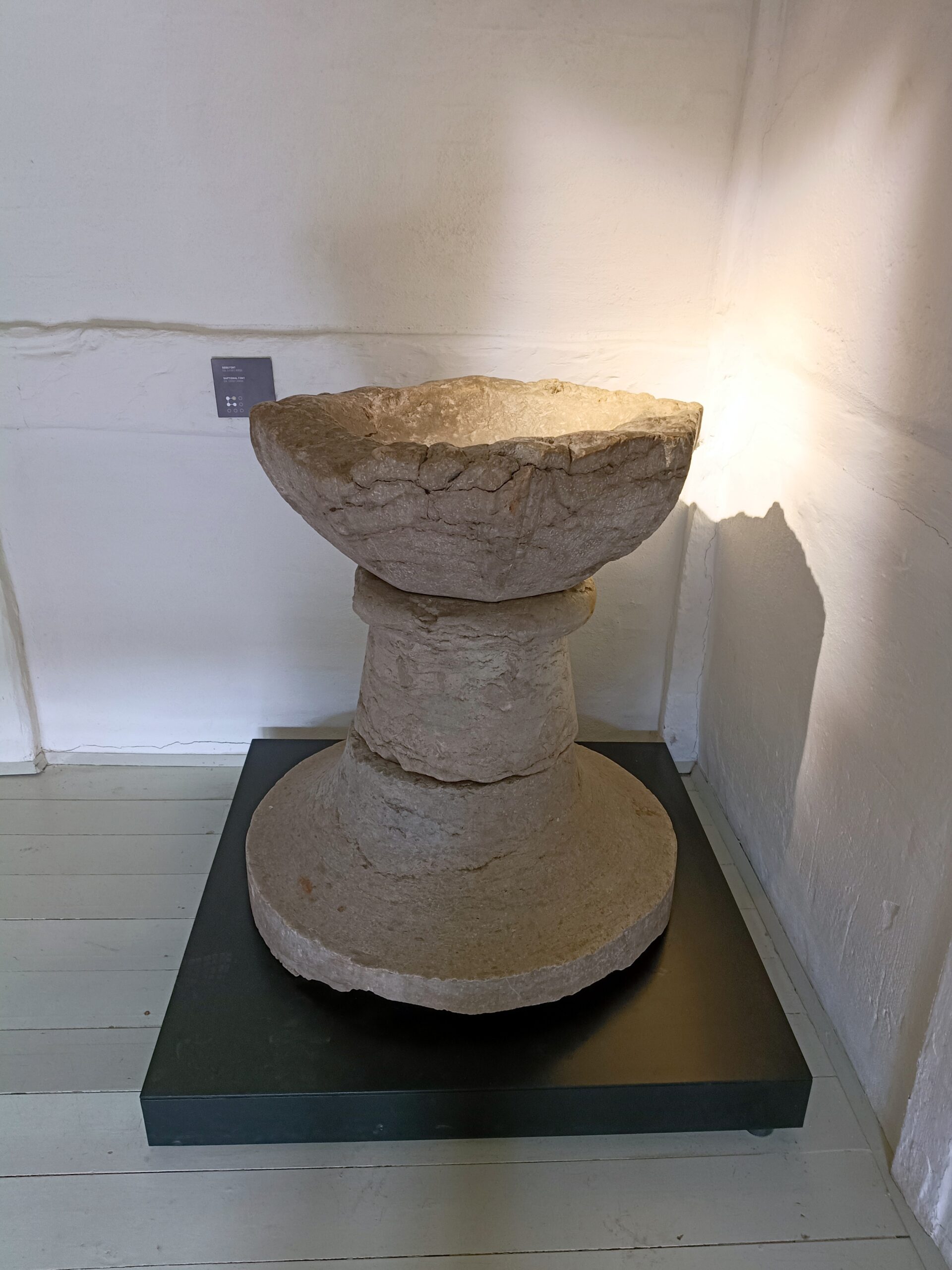
The old Saint Nikolai baptismal fountain, which was instantly removed when the desecration was discovered. It is now displayed at Køge Museum.
A series of trials began in 1612 and unfolded over the next several years. In the wave of prosecutions that followed, sixteen women were condemned to death by burning. While one managed to escape and a few took their own lives before their sentence was to commence, at least thirteen women were still executed by the end of 1615 for their alleged involvement in the Køge Huskors affair—making it the largest, concentrated witch hunt- and execution in Danish history by numbers.
From private notes to the vatican archives
The main reason why we have so many details of the Køge Huskors affair today, is because an account was written down by Anna Bartskjær, some years after the events had subsided. This then circulated around in various handwritten, “underground” copies for decades, before coming to the attention of one Johan Brunsmand, an ordained Lutheran priest and rector of the prestigious Herlufsholm boarding school from 1668 to 1677.
Brunsmand soon started searching for independent confirmation of the fantastic stories. He managed to track down a few elderly citizens of Køge, who professed to still remember the events. This included one of the Bartskjær daughters, Lisbet, who had encountered the entity with the chicken feet in the attic.
Seeking some more official “weight” to the story, Brunsmand contacted the city mayor and council of Køge, who maintained that, even though they could not say what had caused the Køge Huskors, the stories were in their opinion true and had been passed down to them from their predecessors as facts.
Brunsmand was still not quite satisfied, and eventually looked into all the sources available to him that could unequivocally confirm the events. He managed to do this through the city hall’s registers from the period. These records finally convinced him that something out of the ordinary had happened at the merchant’s house.
In 1674 Johan Brunsman published Anna Bartskjærs account, together with his own investigatory findings and commentary, under the title Et forfærdeligt Huus-kaars (“A Terrible House-Cross”).
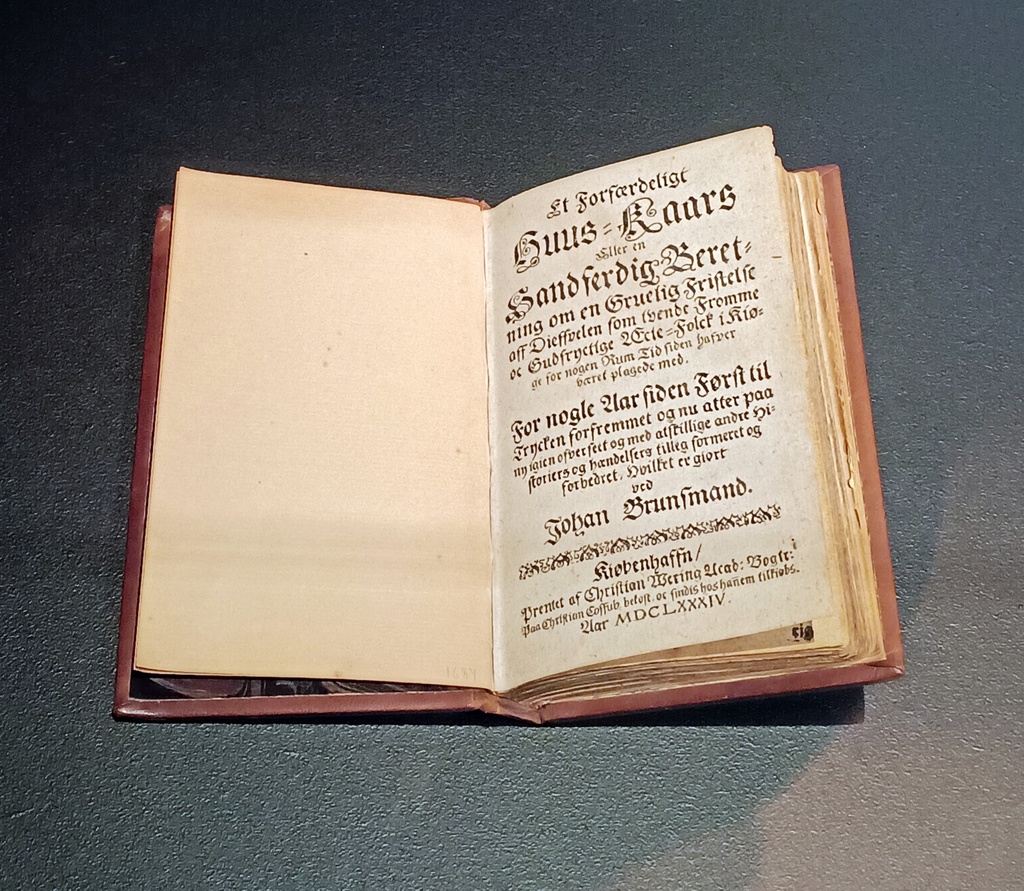
A 1674 first edition copy of Brunsmand’s book, also displayed at Køge Museum as part of an exhibition about Køge Huskors.
The book resonated across Europe; prominent scholars commented on the case, and an official report was compiled for the Vatican, where it reportedly remains preserved in the archives. The volume proved remarkably enduring, seeing numerous translations and editions in Danish, German, and Latin over the years. In 1870 it was published in an edited version by the pioneering Danish socialist leader, Louis Pio, and in 1953 the most recent edition came, with extensive, additional research and commentary by runologist and folklore researcher Anders Bæksted.
While 20th-century scholars analyzed the case through folkloric, parapsychological and clinical psychological lenses, people these days largely view it as a historical curiosity — a novel relic of a bygone era. But one that is very much still kept alive and cherished as part of Køge’s cultural history.
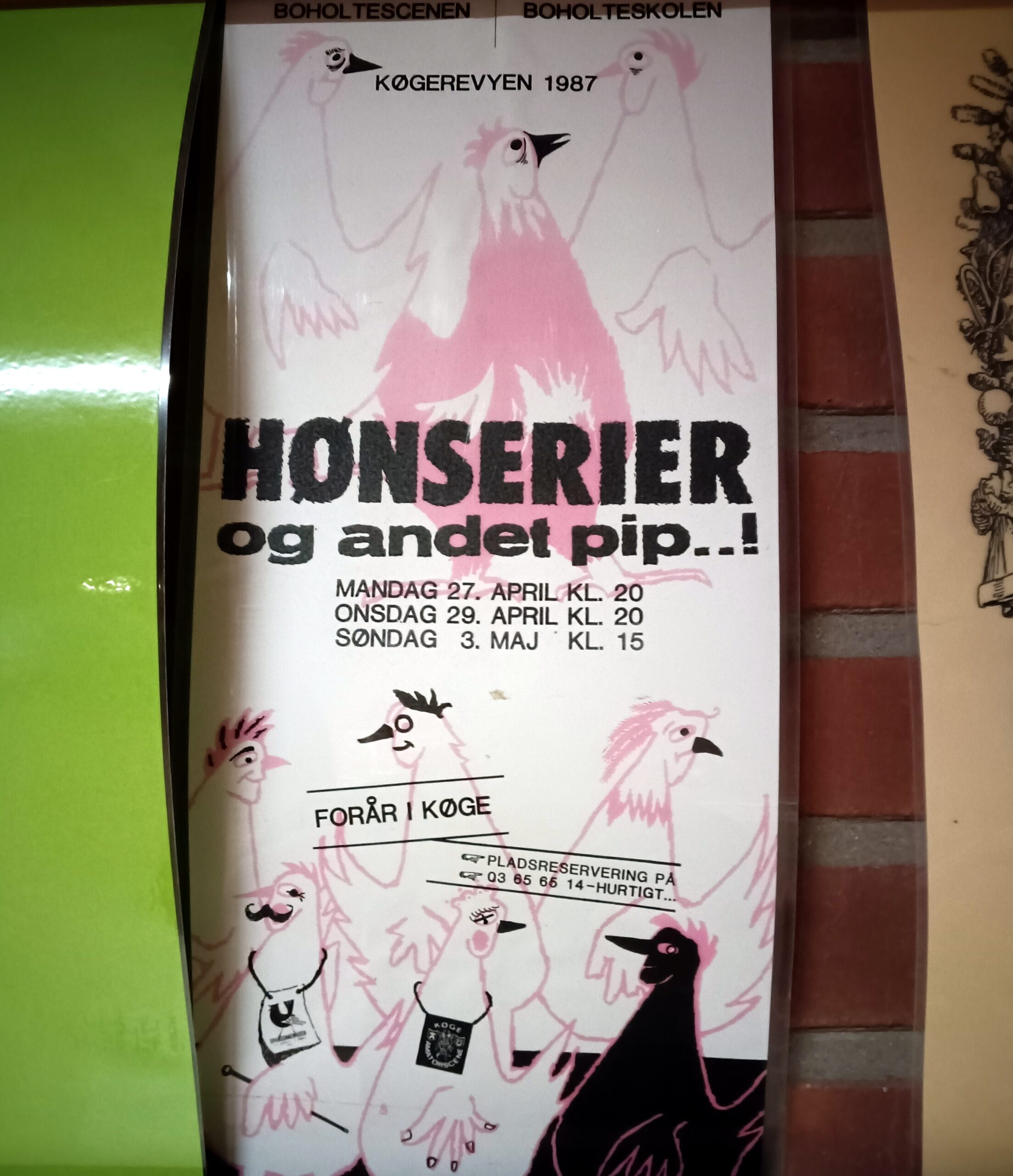
A poster for a 1987 play at Køge Amateur Theatre, that shows the long-lived tradition of chickens and hens associated with the town. For a long time after the events, the Køge Huskors affair was popularly — and later also jokingly — talked about as “The Køge Chicken-Cluck” case or “The Story of The Køge Hens”
Commentary
The Køge Huskors case defies easy categorization. Although it shares elements with poltergeist outbreaks, it departs from the standard trajectory in duration, starting signature, and physical manifestation. Poltergeist disturbances typically resolve within weeks or months and begin with indistinct rappings; the events in Køge, by contrast, persisted for years and were characterized early on by distinct animal sounds and grotesque zoomorphic apparitions.
In many respects, the case mirrors classic accounts of demonic possession more than a conventional haunting: victims suffered levitations, assumed mock-crucifixion poses, and produced vocalizations ostensibly belonging to foreign entities.
While these phenomena do appear sporadically throughout poltergeist literature, the variety and physical violence of the Køge episodes remain extraordinary. The closest historical parallel is found in a case like “The Demon Drummer of Tedworth” (1661), where physical disturbances similarly intersected with religious hysteria.
Crucially, the prominent animal manifestations (such as frogs, birds, and swine) aligned with contemporary belief in witches familiars—an association that would have actively fueled the judicial witch hunt and appears in the trial testimonies.
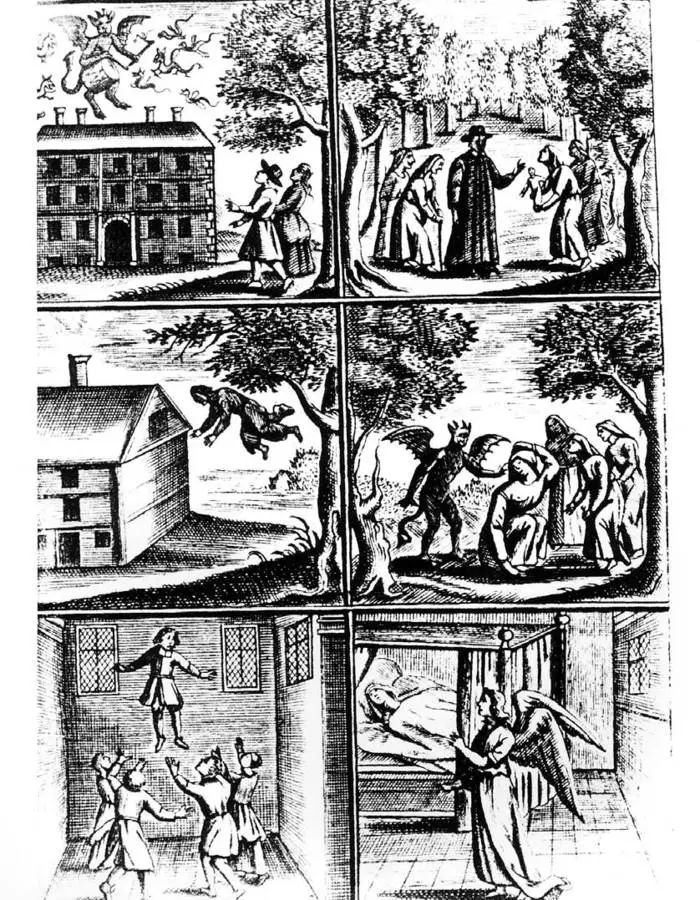
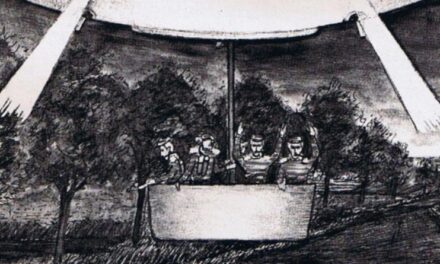
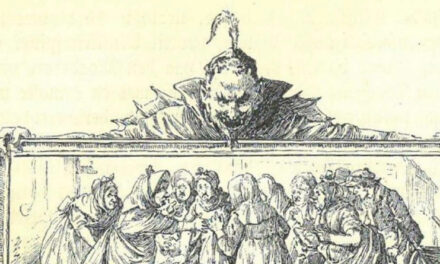
17th century depictions relating to the Drummer of Tedworth case, often referred to as “Britain’s First Poltergeist”. It is easy to spot the parallels to the Køge Huskors affair just from glancing at these images.
At the core of the historical record lies Anne Bartskjær’s personal account. Written down long after the events, when she was an aging woman, her narrative must be approached with sound historical caution. Human memory is reconstructive, and decades of community gossip, severe personal trauma, and post-trial rationalization inevitably warped specific details and amplified dramatic memories.
Yet dismissing the account as pure fabrication would be a mistake. The narrative contains several elements that an early modern merchant’s wife had neither the incentive nor the comparative literature to invent out of whole cloth. We also have the official records that support much of what appears in Anna’s writings. What we are looking at is rather a genuine core of extraordinary disruption—whether rooted in severe psychological strain, profound physical anomaly, or something genuinely inexplicable—heavily refracted through several years of memory and the prevailing demonological worldview of the 17th century.
Regarding Johan Brunsmand, he was undeniably a product of his era and an orthodox Lutheran cleric. He did not compile his work to critique the case from a rationalist perspective, but precisely to counter such lines of thought that aimed to take God out of the equation. Nevertheless, he demonstrated a notable degree of source criticism when cross-referencing witness accounts and municipal records, noting awkward contradictions rather than overlooking them to serve his agenda.
In the end, Brunsmand’s detailed book had an almost immediate — and unintended — positive legacy. By laying bare the coercive methods and catastrophic human cost of the witch trials, Et forfærdeligt Huus-kaars contributed to growing judicial skepticism across Scandinavia—ultimately helping bring an end to the era of legal witch burnings in Denmark.
Select Sources
- Alan Gauld & A.D. Cornell — Poltergeists (1979)
- Anders Bæksted — Køge Huskors for Køge Byting (Fra Københavns Amt, 1951)
- Carl Vett – Kjøge Huskors (Kvartalsskrift for Psykisk Forskning, 1917)
- Chr. Jacobsen — Køge Huskors (Det Ukendte no. 3, 1981)
- L. Hansen — Køge Huskors og Spøgeriet I Resau (Sandhedssøgeren no. 189, November 1912)
- Johan Brunsmand — Et forfærdeligt Huus-kaars… (various editions)
- Jørgen Steen Jensen — Det Berygtede Hus (Skalk no. 5, 1979)
- Mogens Svedstrup — Hvad var “Kjøge Huuskors” egentlig for noget (Okkultisten no. 8, August 1942)
- S. Von Huth — Spiritisme kontra materialisme(1919)