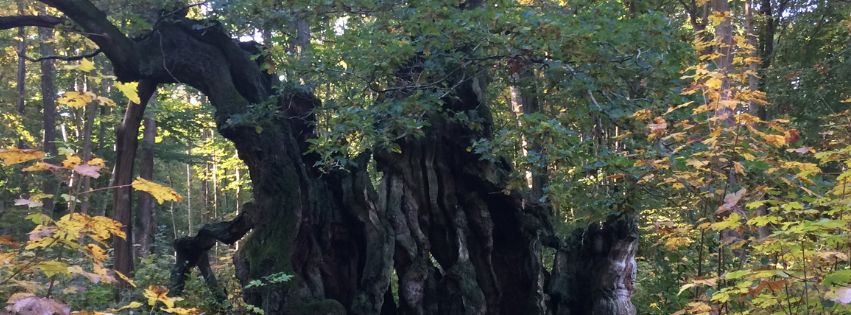
For nearly 2,000 years, the King Oak has occupied its throne in Jægerspris, witnessing and experiencing more than perhaps any other tree in Northern Europe. Read more about the king of the forest here
GPS coordinates: 55.910163, 11.989114
Parking:Visitors arriving by car can park on Barakvej in Kulhuse near the entrance to the forest. Public buses also run directly to the forest entrance, where the bus turns around.
History and legends surrounding the King Oak
Kongeegen, The King Oak, has stood in Jægerspris North Forest for 1,500–1,900 years and is therefore considered one of the oldest oak trees in Northern Europe, perhaps the oldest. It has survived woodland clearance and logging from the Iron Age onwards, and even escaped becoming part of Denmark’s navy under Christian IV. The marshy terrain and coastal meadows along Roskilde Fjord made the tree difficult to reach, and as it continued to grow, myths likely became intertwined with the great tree. Standing face to face with such an ancient being must have inspired awe regardless of whether one was pagan or Christian, and the difficult conditions for tree felling in the area probably contributed even further to the King Oak’s reputation.
The symbolism of the name may have several origins. It may refer to its age, which predates even King Gorm the Old. It may refer to its connection with Jægerspris Castle as a royal residence. It may also refer to a famous event when Frederik VII sought shelter inside the hollow trunk together with Countess Danner while both were still mounted on their horses. It may also refer to the tree’s age and position as the king of the forest and perhaps as a tree of life. It may even have been worshipped as a microcosm of Yggdrasil while remnants of pagan beliefs still existed in the area.
There is a long tradition of viewing trees as entities capable of bringing prosperity and easing transitions, as seen in healing trees and rag trees, which were believed to cure illness, and pacifier trees, which mark a child’s transition from using a pacifier to becoming an older child. The tradition of pacifier trees has survived to the present day, and many examples can still be found throughout Denmark.
The King Oak is a pedunculate oak (Quercus robur), one of the most characteristic and resilient trees in Northern European nature.

The King Oak seen “from the inside,” where the heartwood has long since decayed away, and the trunk remains as the tree’s vital artery.
Visiting The King of The Forest
Experiencing this ancient tree is a unique and, in a way, supernatural experience. For those who are fond of remarkable trees, or perhaps have shamanistic interests or inclinations to witchcraft, the journey may become a tiny pilgrimage of its own.
The tree is located approximately five kilometres from the parking area in Kulhuse, and from there visitors must continue on foot or by bicycle. Along the way, one passes through many different forest types, the most interesting of which is Bredvig Bog, which has been protected and left undisturbed for around one hundred years. Here it is possible to experience a type of nature that comes very close to what Denmark’s original forests may once have looked like.
When you reach the sign indicating the location of the King Oak, you first see it from the road at some distance. Standing there, it appears as a sculptural silhouette that gives wings to the imagination. Depending on one’s inner imagery, it can resemble a dragon, a troll, a bird spreading its wings toward the sky, perhaps a phoenix rising from the ashes. Whether experienced in summer foliage or winter mist, it retains its aura of ancient presence. One must be fairly hard-hearted not to be affected by it.

The King Oak seen from the “front” side, during wintertime.
If you continue further along the forest road, you will find Dyrnæs Pier, formerly used for shipping brick products. Returning from the same direction allows you to view the King Oak from another angle among the trees, where its troll-like presence becomes no less apparent. It takes its rightful place and conveys its own wordless form of communication.
The King Oak’s circumference is today approximately one-third, perhaps only one-quarter, of what it was in its prime, and the tree receives its nourishment solely through the bark, while the inner wood has gradually decayed away. Several supports hold up its branches, but the crown remains alive and full of leaves. The oak is surrounded by a fence that helps protect it from being touched or disturbed by curious visitors.
An oak that has lived for so many years also forms its own biotope and provides a home for numerous species living in its bark, around the trunk, and among its roots
The King’s Family
If the King Oak is the supreme ruler of the forest, it also has two princes or princesses: Storkeegen (The Stork Oak), and Snoegen (The Twisted Oak).
The Stork Oak is found shortly before reaching the King Oak. It received its name from P.C. Skovgaard’s 1843 painting Oak with a Stork’s Nest in North Forest, Jægerspris. In 1965, its age was estimated at 800 years, and its last living branch fell in 1980. Today only a tall hollow stump remains, and the many visitors over the years have worn down the remains of the old tree. Nevertheless, the stump is still impressive, and large branches lie scattered on the forest floor nearby.

The ruins of the Stork Oak, which still cuts a striking figure despite having been dead for more than 45 years.
From the King Oak there is approximately 1.1 kilometres to its other “descendant,” the Twisted Oak, which stands in Øllemosen. It received its name because of its twisted trunk, which developed while the tree stood in denser woodland and had to twist itself towards the light. The last living twigs died in 1991, when the tree had reached an age of 600–700 years. However, the tree remains standing as a peculiar mixture of a troll and a teddy bear, or perhaps a giant creature stretching its arms towards the sky.

Besides the three royal oaks, North Forest offers fairy-tale experiences: gloomy bogs and alder swamps, a wealth of forest types, an old forest pavilion, and if you are not paying attention, it is quite easy to lose your way.