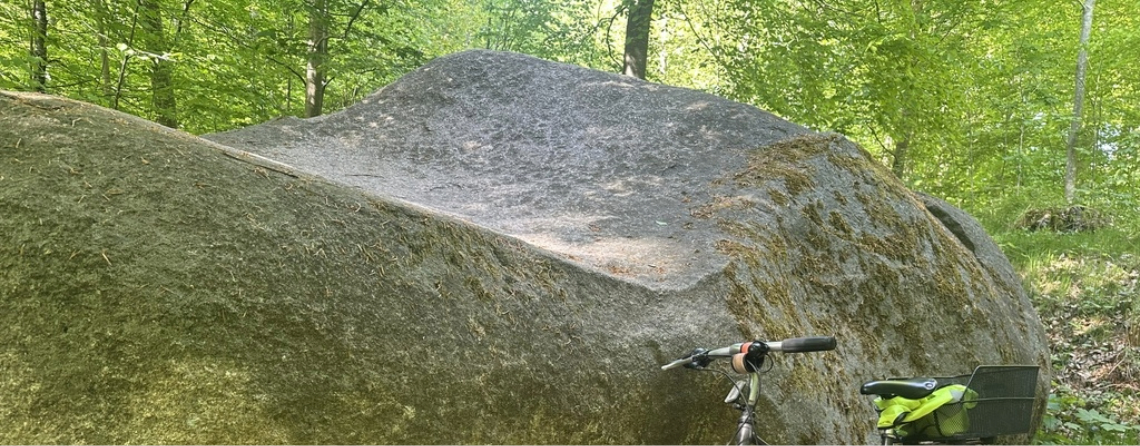
The erratic boulder Sengestenen (‘The Bed Rock’) in Nordskov is both a remarkable relic of the ice age and a witness to the ritual traditions of bronze age communities
Parking:If you come by car via route 57 at Stenlille, there is a spacious parking lot to the left of Nordskovvej at the beginning of the forest near Hjortebjerghus. On the opposite side of the road there is a sign pointing towards Sengestenen.
Nearby attractions: The Blood Stone, The Snare Hill Dolmen, The Cross At Conradineslyst
The landscape of Western Zealand is shaped by the retreat of the glaciers from the land approximately 11,700 years ago, when the Weichselian glaciation gave way to a more temperate climate, creating a rolling moraine landscape strewn with stones and gravel. The landscape is characterized by its rounded hills and lakes formed in kettle holes left by dead ice, such as Tissø and Maglesø. The retreating ice also left behind the larger so-called glacial erratics — rocks of unusual size that evoke the impression of a hidden bedrock thrusting scattered ridges up through the sandy soil layers.
Within this landscape lies Nordskov near Stenlille, a small woodland dominated by beech trees, where the hill Hjortebjerg rises beneath forest cover with a clearing-cairn — a burial mound built from smaller rocks — a remnant of the Bronze Age people who lived here during the period 1700–500 BCE.
A few hundred meters from Hjortebjerg lies the glacial erratic Sengestenen – literally meaning ‘The Bed Rock’, which, with its circumference of 15 meters, is an impressive piece of exposed granite, almost rectangular in shape with a slightly concave surface that invites one to climb up and lie upon it. The rock consists of reddish coarse-grained granite, textured with white plagioclase and gleaming quartz crystals.

The Bed Rock really lives up to its name. A great place to take a rest in between all the everyday hustle and bustle.
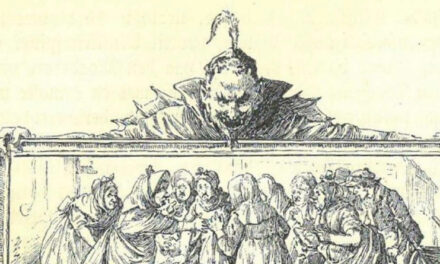
A local legend tells of a troll who grew tired of hearing the church bells in the village of Undløse and therefore hurled the rock at it. The legend does not say where the troll stood in relation to Undløse, but if this was indeed the case, the troll missed its target, since Undløse lies 11 kilometers from Sengestenen.
The Bed Rock also features several cup marks— petroglyphs from the Bronze age formed as small depressions, often 4–10 centimeters in diameter, found throughout most of Scandinavia and bearing witness to widespread ritual activity — can be found on the northern end of the rock, although they are not particularly distinct. The rock lies partially excavated in the forest floor, and whether the Bronze Age people had access to the rock in its full extent is difficult to know. Nevertheless, the rock’s size and surface evoke thoughts of rituals, offerings, and ceremonies.

The beech forest surrounding The Bed Rock is young and bright, a typical Danish production forest. We therefore know nothing of the landscape that surrounded the it during the Bronze Age — whether it was enclosed by the gnarled oak forests of antiquity with their dark and impenetrable undergrowth, or whether the rock stood exposed amidst cultivated land where the sun horse could ride across the sky in direct view of Sengestenen. Yet when one spends time upon the rock’s surface, regardless of the weather, one still experiences a sense of direct connection both to Denmark’s enigmatic prehistory and to the geological forces that tore Sengestenen loose from the bedrock of the North and, through the immense power of the glaciers, carried it into the graceful moraine landscape of Western Zealand.
Sources
- Geus.dk
- Lokalhistorisk arkiv for Sorø og omegn
- Danmarks Naturfredningsforening
- Sjællandske Nyheder